Private, affordable AI for cancer screening
The diagnosis shouldn't depend on your zip code.
SEABED teaches a breast-cancer-screening AI across many clinics at once, without a single patient image ever leaving the room it was taken in. It runs on hardware that costs less than a laptop, over networks slower than most homes have.
A gap AI alone can't close
AI can already read a mammogram as well as a radiologist. Almost no one who needs that gets to use it.
Researchers showed years ago that AI could match specialist-level accuracy in breast cancer screening. That technology still lives almost entirely inside well-funded hospitals. Training it the usual way means pooling thousands of patient scans onto one server — which most clinics legally and ethically can't do. Running it means computing infrastructure that can cost more than a small clinic's annual budget. And even the privacy-conscious alternatives usually assume fast, constant internet, which rural clinics, and much of the world, simply don't have.
Breast cancer is treatable when caught early. Access to the AI that catches it early shouldn't be the rare part.
How SEABED is different
Teach the AI everywhere. Move the data nowhere.
Instead of collecting patient images in one place, SEABED sends the model itself out to each clinic. Only a small, compressed summary of what a device learned comes back — never an image, never anything a patient could be identified from.
The model travels to the clinic
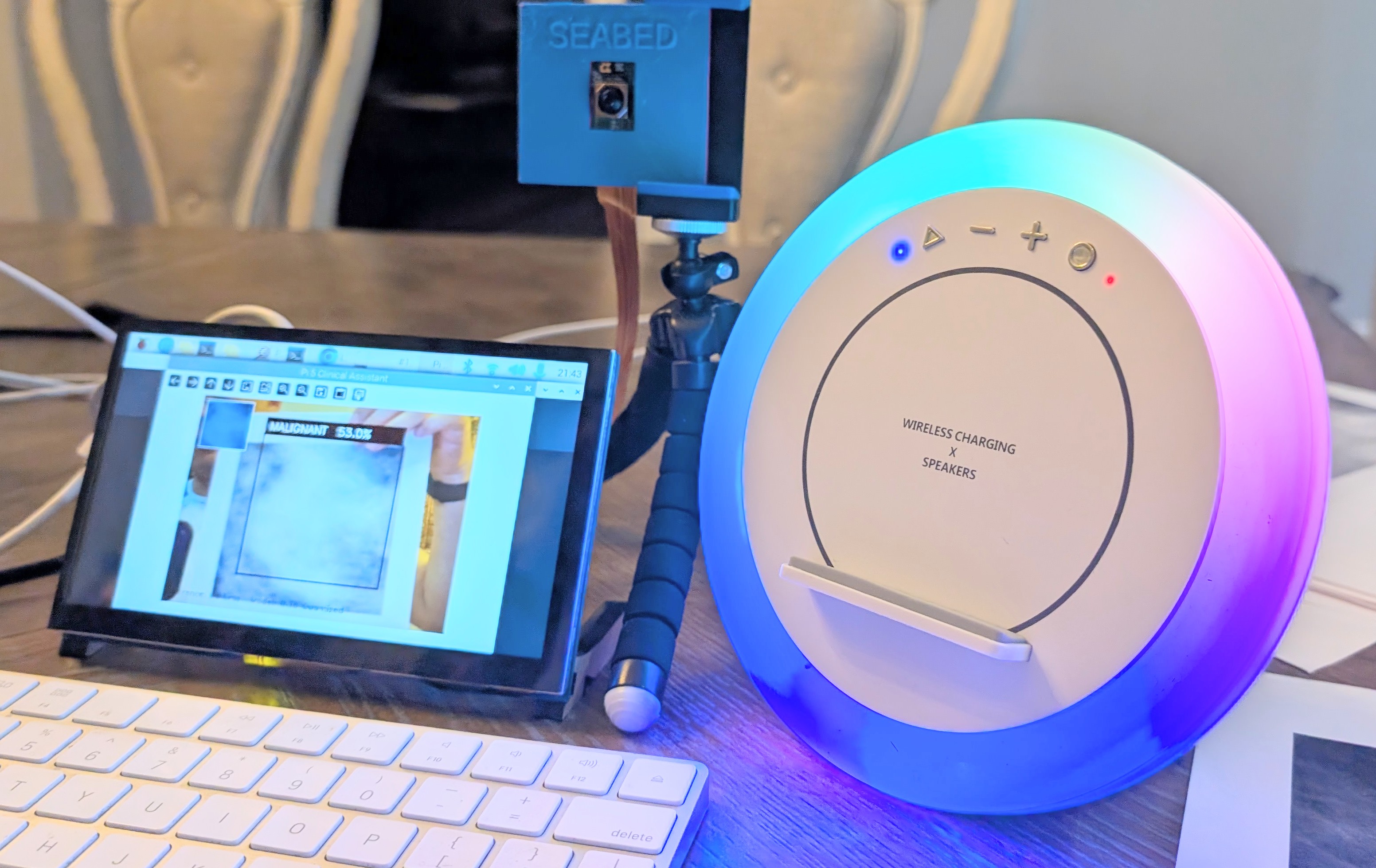
Each clinic runs a small, inexpensive device that holds a copy of the shared model — no data center, no cloud account required to operate it.
The clinic teaches it privately
The device learns from that clinic's own patients, on-site. The images never leave the building, and the device can train without a live internet connection.
Only a small signal comes home
A tiny, compressed update — not an image, not a record, not anything identifiable — is sent back to improve the model every clinic shares.
Who this is for
Built for the clinics everyone else designs around.
Rural and community clinics get access to specialist-grade screening support without a specialist-grade budget or bandwidth.
Patients keep their images in the building where they were taken — no cloud upload, no third-party server, no new place for a breach to happen.
Health systems in low-resource regions can stand up a screening network for the cost of a few laptops, not a data center.
Where this goes
A new default for medical AI in low-resource settings.
If this works for breast cancer screening, the same discipline applies well beyond it: nothing identifiable leaves the clinic, the hardware stays affordable, and it works on the network already in the room.
SEABED is built as a platform, not a single product. Breast cancer screening is the first application proven out — not the last one planned.
What's next
One architecture. Many diagnoses.
SEABED Core
Prototype validatedBreast cancer screening — the flagship system. Real-time scan classification, privacy-preserving training across clinics, and a clinician-facing report.
SEABED Derm
ResearchSkin lesion and melanoma triage on the same privacy-preserving pipeline — one of the most common cancers, and among the most treatable when caught early.
SEABED Retina
ConceptDiabetic retinopathy screening for primary-care clinics that don't have an ophthalmologist on staff — a leading cause of preventable blindness.
SEABED Fleet
ConceptA hosted dashboard for health systems and NGOs to coordinate many SEABED devices across many clinics under one subscription.
Who's building it
Started as one student's question, not a company's roadmap.
SEABED began in 2025 as an independent research project by David Tran, a student at Franklin High School in Elk Grove, California, and will be presented at the California Science and Engineering Fair in 2026.
It builds on breakthroughs in federated learning and AI-assisted cancer screening from researchers worldwide — combined, for the first time, in a way designed to run on hardware a single clinic could actually buy.
Follow along
Follow SEABED from prototype to pilot.
We're looking for clinics, researchers, and early partners who want to help bring low-cost, private cancer screening to more places. Leave your details and we'll be in touch as the next testbed comes together.
Request received
Thanks — we'll follow up as the next SEABED testbed comes together.
hello@seabedmed.com